
Quevedo & Ponce - Legal News
Appellations of Origin in Ecuador: Products That Represent Our Identity to the World
- November 4th, 2026
- Quevedo & Ponce
- Prepared by: Atty. Juan Esteban Ponce
The Legal Significance of Geographical Origin
Why may sparkling wine produced anywhere in the world not freely be marketed as Champagne? What distinguishes authentic Parmigiano Reggiano from similar cheeses? Why do certain agricultural and artisanal products enjoy international recognition intrinsically linked to their place of origin?
The answer lies, to a considerable extent, in appellations of origin (AOs) and geographical indications (GIs): intellectual property rights that identify and protect products whose qualities, reputation or other characteristics are attributable to a particular geographical origin.
In Ecuador, the principal legal framework comprises Decision 486 of the Andean Community (CAN), establishing the Common Industrial Property Regime, and the Organic Code of the Social Economy of Knowledge, Creativity and Innovation (COESCCI), also known as the Código Ingenios.
Article 201 of Decision 486 defines an appellation of origin as a geographical indication consisting of the name of a country, region or specific place, used to designate a product originating therein whose quality, reputation or other characteristics are exclusively or essentially attributable to the geographical environment, including natural and human factors.
An appellations of origin does more than identify where a product was made: it recognizes the distinctive connection between a territory, its natural conditions, production methods and the knowledge of its inhabitants.
Ecuadorian Appellations of Origin
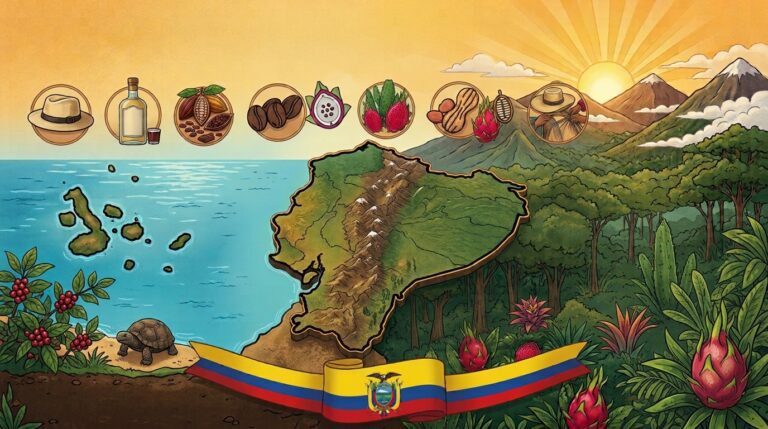
In November 2022, the National Intellectual Rights Service (SENADI) reported that Ecuador had seven recognized appellations of origin:
- Cacao Arriba
- Sombrero de Montecristi
- Café de Galápagos
- Maní de Transkutukú
- Pitahaya Amazónica de Palora
- Lojano café de origen
- El Miske
These designations illustrate Ecuador’s agricultural, artisanal and cultural diversity and the potential for linking intellectual property protection to local economic development.
Comparative Overview of the Seven Ecuadorian Appellations of Origin
Appellation of origin | Protected product | Territorial connection | Distinctive characteristic | Potential benefit |
Cacao Arriba | Fine-flavour cocoa | Delimited cocoa-producing areas of Ecuador | Nacional or Nacional Complex cocoa; floral aromatic profile | Differentiation in international cocoa markets |
Sombrero de Montecristi | Fine toquilla-straw hats | Montecristi, Manabí | Handweaving and traditional know-how | Protection of artisanal reputation and recognition of local craftsmanship |
Café de Galápagos | Coffee | Galápagos Islands | Island origin and distinctive environmental conditions | Differentiation in specialty-coffee markets |
Maní de Transkutukú | Groundnuts (peanuts) | Transkutukú, Amazon region | Local farming practices and knowledge | Recognition of community-based production |
Pitahaya Amazónica de Palora | Dragon fruit (pitahaya) | Palora, Morona Santiago | Organoleptic characteristics and agroclimatic conditions | Positioning in specialty fruit markets |
Lojano café de origen | Coffee | Protected coffee-growing area of Loja | Coffee-growing tradition and geographical characteristics | Strengthening the reputation of Loja coffee |
El Miske | Agave spirit | Delimited Ecuadorian Andean region | Agave processing, fermentation and distillation | Distinct market identity for traditional spirits |
Source: SENADI institutional materials and records concerning Ecuadorian appellations of origin. Precise territorial boundaries and protected specifications are governed by the relevant administrative decisions and conditions of use.
1. Cacao Arriba
Protected product: fine-flavour cocoa beans of the Nacional variety or Nacional Complex, meeting the specifications and requirements established in the declaration of protection.
Protection title: No. 001-10.
Administrative decision: No. 6308541 of 13 February 2009, issued by the then National Directorate of Industrial Property of the Ecuadorian Intellectual Property Institute (IEPI).
Applicants identified in the documentation: Federación Nacional de Productores de Cacao del Ecuador (FEDECADE); Unión de Organizaciones Campesinas Cacaoteras del Ecuador (UNOCACE); Instituto Nacional Autónomo de Investigaciones Agropecuarias (INIAP); and SACICORP S. A.
Cacao Arriba is among Ecuador’s internationally recognized agricultural traditions. Its protection is associated with Nacional or Nacional Complex cocoa, particularly its fine-flavour status and characteristic floral aromatic profile.
These qualities distinguish it from other cocoa varieties traded internationally. The term “Arriba” also has historical significance, linked to cocoa shipped to Guayaquil from producing areas upstream, particularly in the Guayas River basin.
The declaration legally recognizes the connection between the product, its Ecuadorian origin and the natural and human factors contributing to its characteristics.
Significance for producers and Ecuador: the designation distinguishes cocoa meeting the protected specifications, safeguards its reputation and supports positioning in specialty markets. For producing communities, it provides opportunities for collective organization, commercial differentiation and recognition of agricultural knowledge handed down through generations.
2. Sombrero de Montecristi
Protected product: fine toquilla-straw hats made in accordance with the specifications of the protected appellation.
Recognized in 2009, this designation protects an Ecuadorian craft tradition whose international reputation rests on weaving quality and artisanal skill.
It helps establish the product’s Ecuadorian origin, notwithstanding its historical marketing abroad as the “Panama Hat”, and may strengthen the identity of artisan communities and trade in authentic products.
3. Café de Galápagos
Protected product: coffee grown within the delimited geographical area of the Galápagos archipelago in accordance with the conditions of protection.
The appellation recognizes the relationship between coffee production and the islands’ particular natural conditions. Its insular provenance differentiates the product, especially in markets valuing geographical authenticity.
4. Maní de Transkutukú
Protected product: groundnuts originating in the protected Transkutukú geographical area.
This designation is associated with agricultural production by Shuar and Achuar communities in the Ecuadorian Amazon. Recognition offers an opportunity to preserve traditional farming practices, reinforce producer identity and promote differentiated marketing of Amazonian products.
5. Pitahaya Amazónica de Palora
Protected product: pitahaya produced in accordance with the protected specifications in Morona Santiago.
Palora pitahaya is distinguished by its territorial identity and quality and flavour characteristics. The appellation differentiates qualifying production and provides a means of strengthening its reputation in domestic and international markets.
6. Lojano café de origen
Protected product: coffee grown within the protected geographical area of Loja.
The designation recognizes the relationship between Loja’s coffee-growing tradition, local geographical conditions and product characteristics. It may support positioning in specialty-coffee markets while preserving the connection between reputation and place.
7. El Miske
Protected product: a spirit obtained by distilling fermented tzawarmishky made from Andean agave sugars, in accordance with the protected specifications.
El Miske links Andean natural resources, production know-how and spirits-making techniques. Its recognition in October 2022 offers an opportunity to develop a distinct identity in the traditional spirits market and reinforce Ecuador’s agave value chain.
Benefits for Communities and Their Territories
Appellations of origin may contribute to economic and social development by differentiating products, safeguarding their reputation and recognizing the knowledge of producing communities.
Economic: they distinguish products associated with their origin and can create opportunities to access specialty markets and generate greater added value.
Social: they encourage producer organization and the transmission of traditional skills and knowledge.
Cultural and territorial: they reinforce community identity and recognize productive heritage.
These benefits are not automatic. Effective implementation requires oversight mechanisms, authorizations to use the protected designation, producer organization and sound commercial strategies.
Europe: An International Benchmark
Europe is a leading reference point for the protection and commercial development of appellations of origin and geographical indications. Products such as Champagne, Parmigiano Reggiano, Roquefort, Prosciutto di Parma and Queso Manchego have established international reputations closely associated with their geographical provenance.
The European Union operates a specialized system that includes Protected Designations of Origin (PDOs) and Protected Geographical Indications (PGIs). Regulation (EU) 2024/1143 is a principal legislative instrument governing geographical indications for wines, spirit drinks and agricultural products.
European experience demonstrates that origin protection can become a tool for competitiveness when combined with production standards, effective controls, producer organization and commercial promotion.
An Opportunity to Strengthen Ecuador’s International Position
Ecuador’s geographical, climatic, agricultural and cultural diversity offers opportunities to develop additional appellations of origin and geographical indications. Recognition nevertheless requires legal proof of the link between a product’s characteristics and its geographical origin.
Competitiveness does not depend solely on production volumes or low prices. Authenticity, reputation and territorial identity can provide meaningful commercial differentiation.
For Ecuador, strengthening protection may help promote higher-value exports, preserve traditional knowledge and support regional economies.
Conclusion
An appellation of origin does not merely protect a product name. It legally recognizes and safeguards the relationship between a territory, its natural conditions, its productive know-how and the reputation built around them.
The challenge is to translate legal recognition into tangible economic opportunities through organization, oversight, commercial promotion and enforcement of intellectual property rights.
In international markets that increasingly value authenticity and provenance, appellations of origin can provide a strategic means of strengthening Ecuador’s position.
Quevedo & Ponce | Intellectual Property
Legal information article on appellations of origin and their significance for territorial development and international trade.
Appellations of Origin in Ecuador: Products That Represent Our Identity to the World
Intellectual property protects not only inventions, trademarks and artistic creations, but also the identity of territories, their traditional products and the knowledge of the communities that produce them.

Data Protection in Ecuador: Who Does It Apply To?
The LOPDP regulates how personal information is collected, used, stored, shared, and deleted, whether it is handled physically or digitally. Compliance is not simply a matter of publishing a privacy policy on a website; it requires incorporating data protection measures into the organization’s activities.

Are promises to enter into a contract binding on the parties?
Before signing a final contract, it is common to use letters of intent or promises to contract as part of the negotiation process. These tools protect the interests of all parties when executed in compliance with the law.

Use of Digital Avatars: An Appropriate Measure Against Organized Crime?
Through Resolution No. 164-2026, the Plenary of Ecuador’s Council of the Judiciary approved the Technical-Operational Protocol for the Use of Digital Avatars as a Security Measure in Remote Hearings, introducing a new technological tool intended to mitigate certain risks faced by judges and other judicial officers.

Plant Varieties in Ecuador: Protecting Innovation in the Agricultural Sector
The development of new plant varieties represents an important source of innovation in the agricultural sector.