

Quevedo & Ponce - Noticias Legales
The Constitutional Court guarantees the right to maternity leave even in the event of the newborn's death
- May 8th, 2025
- Quevedo & Ponce
On September 4, 2018, a woman gave birth via cesarean section and was granted maternity leave until November 26. Following the death of her child on September 16, officials from the Judiciary Council requested that she justify her absence with a leave for domestic calamity, even though her original medical certificate remained valid. Despite her insistence that she had the right to maintain her maternity leave under the LOSEP Regulations, she was informed that such right was extinguished by the death of the baby, according to an interpretation of the Organic Law of the Judicial Function. As a result, the National Directorate of Human Talent decided to suspend her leave, prompting the claimant to file a lawsuit for violation of her rights to maternity protection, health, care, and equality, as her need for physical and emotional recovery after childbirth and the loss of her child had not been recognized.
In response, the Court raised the following question:
Did the decision of the Provincial Directorate of Ibarra to refer for consultation the validity of the maternity leave violate the claimant’s right to protection as a woman in a period of maternity?
The Constitution of Ecuador recognizes pregnant, postpartum, or breastfeeding women as a priority group, guaranteeing their health and recovery. Both national and international regulations (CEDAW and the Constitution) establish that the right to health includes not only the absence of illness but also comprehensive well-being, which is especially important for women undergoing postpartum recovery or grieving a neonatal loss. CEDAW also requires that maternity leave be respected without affecting employment or benefits. The Court acknowledged that, although there may be normative ambiguity between the COFJ and the LOSEP Regulation, such consultation does not justify suspending the exercise of a fundamental right.
As a result, the Court determined that the claimant’s rights to priority protection, health, and dignified postpartum recovery were violated, and urged public institutions to refrain from repeating such practices.
At Quevedo & Ponce, we assist companies and workers to ensure compliance with legal provisions and protect labor rights. Contact us for advice on this important precedent and its impact on the labor field.
Más Artículos
Are promises to enter into a contract binding on the parties?
Before signing a final contract, it is common to use letters of intent or promises to contract as part of the negotiation process. These tools protect the interests of all parties when executed in compliance with the law.

Use of Digital Avatars: An Appropriate Measure Against Organized Crime?
Through Resolution No. 164-2026, the Plenary of Ecuador’s Council of the Judiciary approved the Technical-Operational Protocol for the Use of Digital Avatars as a Security Measure in Remote Hearings, introducing a new technological tool intended to mitigate certain risks faced by judges and other judicial officers.

Plant Varieties in Ecuador: Protecting Innovation in the Agricultural Sector
The development of new plant varieties represents an important source of innovation in the agricultural sector.
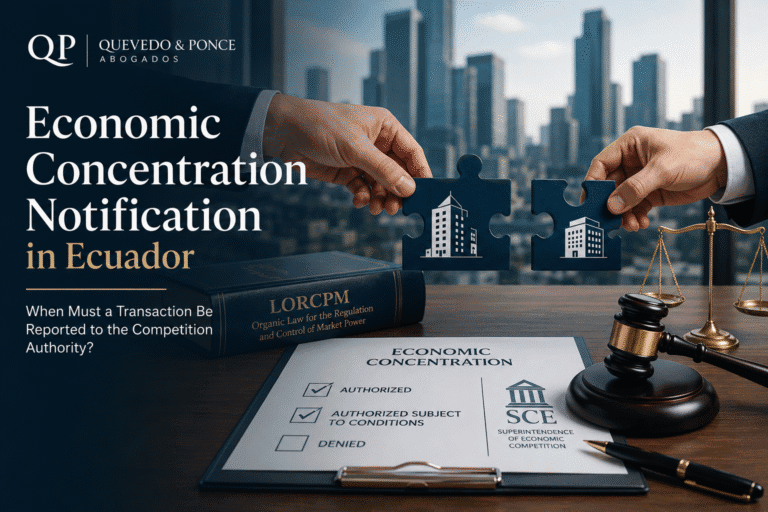
Economic Concentrations in Ecuador
Mergers, acquisitions, and transactions involving a change of control may be subject to Ecuador’s economic concentration control regime. The applicable rules establish specific thresholds to determine when a transaction must be notified in advance to the Superintendence of Economic Competition and allow the authority to authorize, condition, or prohibit a transaction depending on its effects on competition.

The right to remain unpublished and the posthumous publication of Gabriel García Márquez’s work “See You in August”
We all celebrate being able to read one more work by García Márquez, but what about respect for his copyright? The posthumous publication of “See You in August” has reignited the debate over the right to remain unpublished, an inalienable moral right that empowers creators to decide whether their work is released or remains unpublished. Although the Colombian Nobel laureate expressed his intention not to publish it during his lifetime, his heirs authorized its publication, raising an ethical and legal dilemma regarding the limits of rights heirs as custodians of the author’s original intent.