

Quevedo & Ponce - Noticias Legales

Ecuador and the Netherlands Strengthen customs control and Intellectual Property protection

On June 19, 2025, the Second Supplement of the Official Register No. 63 formalized the publication of the Agreement between the Kingdom of the Netherlands and the Republic of Ecuador on Mutual Administrative Assistance in Customs Matters.

This agreement marks a key milestone in bilateral cooperation aimed at preventing, detecting, and investigating customs violations, including smuggling, commercial fraud, and the counterfeiting of products protected by intellectual property rights. It establishes effective collaboration mechanisms between the customs authorities of both countries, including:

  • Exchange of strategic and operational information.
  • Notification of documents and administrative rulings.
  • Coordinated surveillance of goods, means of transport, and individuals under suspicion.
  • Mutual assistance in specific customs investigations. 


Moreover, the agreement strengthens the implementation of border measures in line with international standards, safeguarding trademarks, copyrights, and industrial designs from infringement through counterfeit or pirated goods. It also provides for stricter controls, particularly for goods in transit or intended for export or import between both jurisdictions.

The agreement ensures the confidentiality and lawful use of shared information, respecting the principles of legality, necessity, and proportionality.

This development has a direct impact on customs control authorities, foreign trade operators, and holders of intellectual property rights, all of whom will benefit from enhanced international coordination to combat piracy, counterfeiting, and other cross-border crimes.

At Quevedo & Ponce, we provide comprehensive legal counsel in the protection and enforcement of intellectual property rights, legal actions for infringement or counterfeiting, implementation of border measures before SENADI and the Ecuadorian Customs Service (SENAE).

Más Artículos

Are promises to enter into a contract binding on the parties?

Are promises to enter into a contract binding on the parties?

Before signing a final contract, it is common to use letters of intent or promises to contract as part of the negotiation process. These tools protect the interests of all parties when executed in compliance with the law.

Use of Digital Avatars: An Appropriate Measure Against Organized Crime?

Use of Digital Avatars: An Appropriate Measure Against Organized Crime?

Through Resolution No. 164-2026, the Plenary of Ecuador’s Council of the Judiciary approved the Technical-Operational Protocol for the Use of Digital Avatars as a Security Measure in Remote Hearings, introducing a new technological tool intended to mitigate certain risks faced by judges and other judicial officers.

Plant Varieties in Ecuador: Protecting Innovation in the Agricultural Sector

Plant Varieties in Ecuador: Protecting Innovation in the Agricultural Sector

The development of new plant varieties represents an important source of innovation in the agricultural sector.
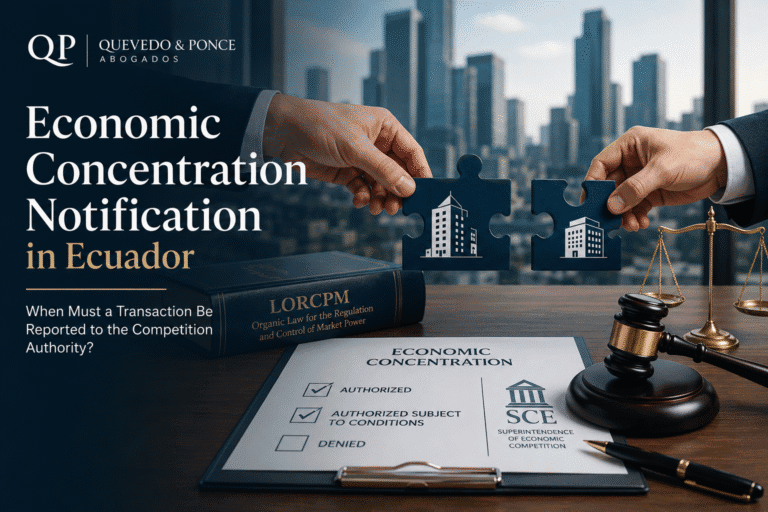
Economic Concentrations in Ecuador

Economic Concentrations in Ecuador

Mergers, acquisitions, and transactions involving a change of control may be subject to Ecuador’s economic concentration control regime. The applicable rules establish specific thresholds to determine when a transaction must be notified in advance to the Superintendence of Economic Competition and allow the authority to authorize, condition, or prohibit a transaction depending on its effects on competition.

The right to remain unpublished and the posthumous publication of Gabriel García Márquez’s work “See You in August”

The right to remain unpublished and the posthumous publication of Gabriel García Márquez’s work “See You in August”

We all celebrate being able to read one more work by García Márquez, but what about respect for his copyright? The posthumous publication of “See You in August” has reignited the debate over the right to remain unpublished, an inalienable moral right that empowers creators to decide whether their work is released or remains unpublished. Although the Colombian Nobel laureate expressed his intention not to publish it during his lifetime, his heirs authorized its publication, raising an ethical and legal dilemma regarding the limits of rights heirs as custodians of the author’s original intent.

1 2 3 … 17