

Quevedo & Ponce - Legal News

Impacts of the U.S.–Iran Conflict on Ecuador: Legal, Commercial and Strategic Perspectives

The conflict between the United States and Iran has moved beyond the geopolitical sphere to become a concrete risk factor for the global economy. The International Energy Agency (IEA) has indicated that disruptions in hydrocarbon transit through the Strait of Hormuz — through which approximately 20% of global oil trade flows — are generating the most significant energy crisis since the 1970s.

As a fuel-importing country, Ecuador faces the impact of this crisis on several fronts:

  1. Pressure on the trade balance and increased costs of fuel and derivative imports.
  2. Rising logistics and transportation costs that are passed on to intermediate goods and final products.
  3. Imported inflation affecting productive sectors linked to energy and transportation prices.


From a legal perspective, this environment has direct implications for the legal certainty of international contracts involving Ecuadorian companies. Market volatility is not merely economic; it affects the performance, enforcement, and renegotiation of supply, transportation, and global service agreements. Many contracts are not prepared for extreme geopolitical events unless they contain
robust force majeure clauses, hardship provisions, or effective mechanisms for renegotiation and termination.

For Ecuador, this situation entails both risks and opportunities. Unintentional breaches resulting from poorly defined force majeure events may lead to international disputes or unforeseen costs. Economically, companies bound by rigid contracts may experience margin deterioration or face cross-border litigation. Strategically, however, companies that anticipate risk scenarios can review and strengthen their contractual frameworks, incorporate price adjustment mechanisms, periodic review clauses, and foreign exchange risk management strategies.

Furthermore, Ecuador’s trade policy — in a world where major geopolitical decisions can redefine routes and markets — must evolve toward regulatory structures that enhance predictability and legal certainty for both domestic and foreign investors. Comparative experience demonstrates that jurisdictions with clear and stable rules attract investment flows even in times of global uncertainty, whereas regulatory unpredictability reduces the attractiveness of high-value projects.

Ultimately, the U.S.–Iran conflict is not a remote event for Ecuador. It represents a tangible impact on the country’s economy, contractual stability, and overall business legal security.

Más Artículos

Plant Varieties in Ecuador: Protecting Innovation in the Agricultural Sector

Plant Varieties in Ecuador: Protecting Innovation in the Agricultural Sector

The development of new plant varieties represents an important source of innovation in the agricultural sector.
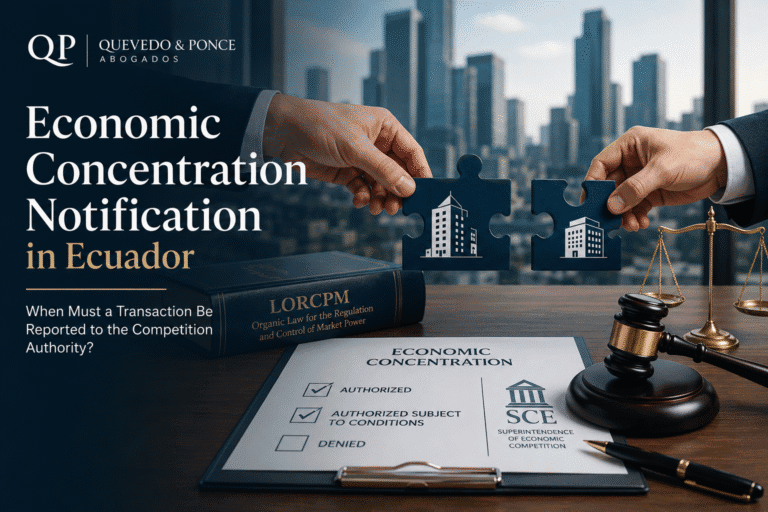
Economic Concentrations in Ecuador

Economic Concentrations in Ecuador

Mergers, acquisitions, and transactions involving a change of control may be subject to Ecuador’s economic concentration control regime. The applicable rules establish specific thresholds to determine when a transaction must be notified in advance to the Superintendence of Economic Competition and allow the authority to authorize, condition, or prohibit a transaction depending on its effects on competition.

The right to remain unpublished and the posthumous publication of Gabriel García Márquez’s work “See You in August”

The right to remain unpublished and the posthumous publication of Gabriel García Márquez’s work “See You in August”

We all celebrate being able to read one more work by García Márquez, but what about respect for his copyright? The posthumous publication of “See You in August” has reignited the debate over the right to remain unpublished, an inalienable moral right that empowers creators to decide whether their work is released or remains unpublished. Although the Colombian Nobel laureate expressed his intention not to publish it during his lifetime, his heirs authorized its publication, raising an ethical and legal dilemma regarding the limits of rights heirs as custodians of the author’s original intent.

The UBS Case: When Having a Compliance System Does Not Mean Controlling Risk

The UBS Case: When Having a Compliance System Does Not Mean Controlling Risk

UBS is one of the world’s largest financial groups. Headquartered in Switzerland, it provides private banking, wealth management, investment management and investment banking services. Its United States operations include UBS Financial Services Inc., a company that provides financial and investment services to clients.

Relevant Market in Ecuador Competition Law: How Is It Defined?

Relevant Market in Ecuador Competition Law: How Is It Defined?

The relevant market is one of the fundamental concepts in Competition Law, as it defines the scope in which companies compete and helps determine whether a particular conduct may affect market competition. Its proper definition is essential for assessing anticompetitive practices, abuse of market power, and merger control

1 2 3 17