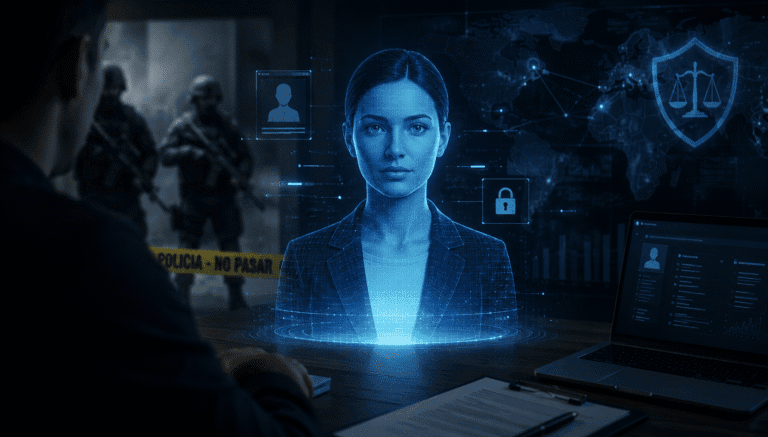
Through Resolution No. 164-2026, the Plenary of Ecuador’s Council of the Judiciary approved the Technical-Operational Protocol for the Use of Digital Avatars as a Security Measure in Remote Hearings, introducing a new technological tool intended to mitigate certain risks faced by judges and other judicial officers.
The Protocol provides that the use of institutional digital avatars constitutes a preventive technological measure designed to protect the judge’s biometric identity during remote hearings. According to the regulation itself, this is an extraordinary measure aimed at mitigating risks associated with automated facial recognition, the unlawful collection of images, biometric profiling, and other activities that may compromise the security of judicial officers or their families.
The stated purposes include protecting the biometric data and personal safety of judicial officers, as well as strengthening judicial independence and impartiality.
The objective pursued is legitimate. The issue that must be examined is whether the mechanism chosen is actually suitable for achieving that objective and whether it addresses the real security problem currently faced by Ecuador’s Judiciary.
The Problem Is Not Merely the Exposure of a Judge’s Image
Attorney Alejandro Ponce Villacís, in an interview with Radio Pichincha, questioned the effectiveness of digital avatars as a mechanism for protecting the personal safety of judges.
His criticism points to a deeper problem: in the context of organized crime, digitally concealing or altering a judicial officer’s image during a hearing is not equivalent to protecting that person.
Criminal organizations do not necessarily depend on a photograph obtained during a remote hearing to identify a judge, prosecutor, or law-enforcement officer. Public officials who investigate, prosecute, or adjudicate organized-crime cases operate within institutional proceedings in which their identities may become known through multiple channels.
Accordingly, the State’s response should focus primarily on reducing the physical and operational vulnerability of public officials and their immediate families through professional risk-assessment systems, intelligence capabilities, personal protection, secure transportation, emergency-response protocols, and effective inter-agency coordination.
Digital Avatars and the Principle of Immediacy
The Council of the Judiciary has stated that the use of digital avatars does not amount to establishing a system of “faceless judges.” Nevertheless, their use raises significant questions from the standpoint of the principle of immediacy.
Immediacy requires direct interaction between the judge, the parties, and the other participants in judicial proceedings. Judicial communication is not limited exclusively to spoken words: facial expressions, reactions, and other forms of non-verbal communication may form part of the interaction occurring during a hearing.
Replacing the judge’s actual image with a digital representation may diminish that direct interaction and may also give rise to an additional concern: what mechanisms enable the parties to unequivocally verify that the person behind the avatar is in fact the competent judge rather than a third party?
Technology intended to enhance judicial security should not create new uncertainty regarding the identity of the judicial officer exercising adjudicatory authority.
A Measure Intended Precisely for the Highest-Risk Proceedings
The Protocol allows the use of avatars to be considered in proceedings involving organized crime, drug trafficking, contract killings, terrorism, and other particularly complex cases. Factors that may be considered include prior threats, acts of intimidation, multiple defendants, membership in domestic or transnational criminal organizations, and other circumstances indicating heightened risk.
Moreover, its scope is not necessarily limited to judges. Where appropriate, it may extend to victims, protected witnesses, court clerks, and other Judiciary officials.
Precisely because these individuals may face real and potentially lethal risks, the discussion should not be limited to preventing a criminal organization from capturing a judicial officer’s image during a videoconference.
The central question is different: how can the State prevent that organization from locating, intimidating, attacking the official, or targeting his or her family?
The Italian Model: Protecting the Official and Protecting the System
Italy’s experience provides relevant guidance for this debate.
Italy progressively developed a specialized protection system for individuals exposed to extraordinary risks arising, among other circumstances, from the fight against organized crime and Mafia organizations. Since 2002, the Ufficio Centrale Interforze per la Sicurezza Personale (UCIS) — the Central Inter-Agency Office for Personal Security — has operated under the Department of Public Security of the Italian Ministry of the Interior.
The model is based on a fundamentally different principle: security cannot depend exclusively on an individual official’s ability to protect himself or herself. A specialized State structure must assess the risk and provide a response proportionate to that risk.
UCIS integrates capabilities from different law-enforcement agencies and performs functions related to risk assessment and analysis, implementation of protection arrangements, training of security personnel, and management of the resources and equipment required for protective operations.
Protection arrangements are tailored to the assessed threat level. Depending on the degree of risk, they may range from one or two security officers and a vehicle to considerably more robust protective details involving several armored vehicles and specialized protection teams.
Italian prosecutor Nicola Gratteri, widely known for his investigations against the ’Ndrangheta and for having lived under stringent security measures for decades, is one of the best-known examples of this model.
There is, however, an additional element that is particularly relevant to Ecuador: a robust protection system does not merely protect individuals; it protects institutional continuity.
Organized Crime Must Not Be Able to Neutralize the State by Eliminating or Intimidating a Single Individual
Fighting organized crime requires understanding that threats are not directed solely against the life of a particular judge, prosecutor, or police officer. Their purpose is often to derail an investigation, influence a judicial decision, or intimidate other public officials.
An effective comprehensive protection system must therefore ensure that threatening, intimidating, or even attacking a particular official becomes ineffective as a means of achieving a criminal objective.
The State’s institutional structure must ensure that another official can immediately continue the relevant investigation, prosecution, adjudication, or law-enforcement operation, with the same institutional backing and appropriate security measures.
This also creates a fundamental deterrent effect: the public official knows that the State stands behind him or her, while the criminal organization knows that intimidating one individual will not paralyze the State.
Subject to the necessary distinctions, this approach is comparable to the protection afforded to the highest-ranking State authorities: the objective is not to conceal their identities, but to establish a professional security structure around them that substantially reduces their vulnerability.
This is precisely one of the features of the Italian model that Ecuador should consider adapting to its own institutional and security environment.
Threats Against Ecuador’s Judiciary Require a Structural Response
The need to strengthen the protection of judicial officers is not hypothetical.
According to the cited statistics of the Council of the Judiciary, between January 2024 and May 2026 there were reportedly 142 threats against judicial officers, 11 attacks against officials, and three attacks against Judiciary infrastructure.
Cases such as that of anti-corruption judge Carlos Serrano, who has reported threats and serious problems concerning his security arrangements, illustrate the shortcomings of the current system.
Even more serious is the murder of Judge Lady Pachard in May 2026. The circumstances surrounding the protection measures assigned to her, and the manner in which those measures were actually implemented, should be subject to rigorous institutional scrutiny.
These cases demonstrate that Ecuador’s judicial-security challenge extends far beyond the biometric exposure resulting from participation in a remote hearing.
From Digital Avatars to a Genuine National Protection System
Technological tools may legitimately form part of a broader security policy. The problem arises when a technological measure of limited scope is expected to address a phenomenon that requires a comprehensive solution.
Ecuador should consider creating or strengthening a specialized inter-agency protection system for judges, prosecutors, and other public officials particularly exposed to organized crime, drawing upon international experiences such as the Italian model while adapting them to Ecuador’s legal and institutional framework.
Such a system should include, at a minimum, periodic technical risk assessments; preventive intelligence; protection of the official and, where necessary, his or her immediate family; professionally trained protective details; appropriate vehicles and equipment; secure transportation and residential-security protocols; immediate response mechanisms in the event of threats; effective coordination among the National Police, Office of the Attorney General, Judiciary, and other competent institutions; and mechanisms ensuring the continuity of investigations and proceedings whenever an official is threatened.
Protection measures should also not depend upon administrative decisions capable of being used as a means of exerting pressure on the protected official. The assignment, modification, or withdrawal of security measures should be based exclusively on objective and professional risk assessments.
Protecting Those Who Stand on the Front Line
Judicial independence is not guaranteed by digitally concealing the faces of those who administer justice. It is guaranteed by creating the conditions necessary for judges, prosecutors, and law-enforcement officers to confront organized crime openly without unjustifiably endangering their own lives or those of their families.
Digital avatars may mitigate certain risks associated with the capture and processing of biometric images. However, standing alone, they can hardly constitute an adequate response to threats, attacks, contract killings, or criminal organizations capable of identifying and locating public officials.
The Italian experience demonstrates a different approach: identify the risk, physically protect the official, provide institutional backing, and ensure that State action continues regardless of threats directed against any particular individual.
Consequently, the debate surrounding Resolution No. 164-2026 should extend beyond the technological merits of digital avatars.
The truly important question is:
Does Ecuador have a sufficiently robust system to ensure that no judge, prosecutor, or law-enforcement officer is forced to choose between performing his or her public duties and protecting his or her own life and family?
As long as the answer remains negative, judicial independence and the State’s ability to effectively combat organized crime will remain vulnerable.
References
– Council of the Judiciary of Ecuador. Resolution No. 164-2026. Technical-Operational Protocol for the Use of Digital Avatars as a Security Measure in Remote Hearings (2026).
– Radio Pichincha. Alejandro Ponce: Use of Digital Avatars for Judges Does Not Guarantee Their Protection (2026).
– Nissolino Academy. Scorta di sicurezza, come funziona l’UCIS: la guida completa.
– Lowen, M. (2023). Nicola Gratteri, el hombre al que quiere matar la mafia más poderosa de Italia. BBC Mundo.